[Back to Blog](/blog) # Teigha Mechanical: Bill Of Materials Physical Data Model in OdDbDatabase
Andrii Morozov October 31, 2017 [\#mechanical](/blog/tag/mechanical) [\#getting started](/blog/tag/getting-started)
Bill Of Materials is a table that holds all parts and components with corresponding data and attributes. The logical representation is quite easy to understand but the physical data model of a BOM table is a complex concept that includes components, parts and data containers.
#### Mechanical dictionary
All common data that relates to Teigha Mechanical is located in a couple of dictionaries, particularly AcmDictionary.
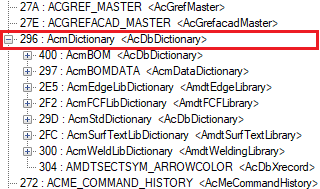AcmDictionary in the database
AcmDictionary holds data related to Bill Of Materials: AcmBOM dictionary and AcmDataDictionary. Also the dictionary holds some common data such as the standards dictionary.
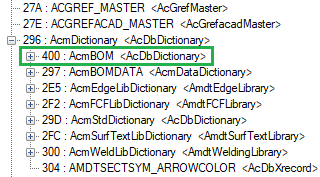BOM dictionary
#### Mechanical data dictionary
Another important dictionary is the AcmBOMDATA dictionary. This dictionary relates to AcmDataDictionary. Basically, AcmBOMDATA holds data containers for BOM rows and BOM tables.
A data container can be any of the following types: DataEntry, DataEntryPart, or DataEntryBlock. The AcmDataDictionary class handles and works with BOM Data:
```
OdResult append(AcmDataEntryPtr pDataEntry, OdDbObjectId& newObjId);
OdResult createDataEntryFor(AcmBomPtr& pBom, const OdDbObjectId& targetId, OdDbObjectId& objId);
OdResult createDataEntryFor2DCompDef(const OdDbObjectId& targetId, OdDbObjectId& objId);
OdResult createDataEntryFor(const OdDbBlockTableRecordPtr& pBlockTableRecord, OdDbObjectId& objId);
OdResult getDataEntryByCompDefId(const OdDbObjectId& compDefId, OdDbObjectId& dataEntryId) const;
```
- append(AcmDataEntryPtr pDataEntry, OdDbObjectId& newObjId) — Adds a new data entry container to an existing dictionary.
- createDataEntryFor() — This group of methods creates new data entry containers.
- getDataEntryByCompDefId(const OdDbObjectId& compDefId, OdDbObjectId& dataEntryId) — Returns the data entry container for a component definition object.
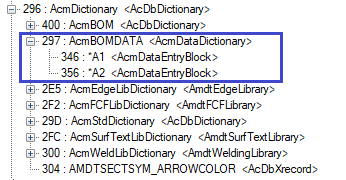BOMData dictionary and DataEntries
#### DbInfo service class
AcadmDbInfo is a service class that works with AcmDataDictionary. This service class is designed to make working with Teigha Mechanical dictionaries easier.
```
OdDbObjectId acmDictionaryId();
OdDbObjectId bomDictionaryId();
OdDbObjectId dataDictionaryId();
OdDbObjectId createBomDictionary();
```
- acmDictionaryId() — Returns the AcmDictionary OdDbObjectId for the current database.
- bomDictionaryId() — Returns the AcmBOM OdDbObjectId for the current database.
- dataDictionaryId() — Returns the AcmBOMDATA OdDbObjectId for the current database.
- createBomDictionary() — Creates a new AcmBOM dictionary for the current database if it's missing.
#### BOM objects
The AcmBom class represents a Bill Of Materials table object. An AcmBom object holds a data entry container with appropriate data for the BOM table and BOM rows that represent BOM items.
```
OdString name() const;
OdDbHardPointerId dataEntryId() const;
void setDataEntryId(OdDbHardPointerId objId);
void setName(OdString name);
bool isExpandedBOM() const;
OdInt16 itemNumberStep() const;
OdString itemNumberStart() const;
void setItemNumberStart(const OdString& itemNumberStart);
void setItemNumberStep(OdInt16 itemNumberStep);
```
- dataEntryId() — Returns the BOM table data container.
- setDataEntryId(OdDbHardPointerId objId) — Sets a data container for the BOM table.
- name() — Returns the name of the BOM table.
- setName(OdString name) — Sets a name for the BOM table.
- isExpandedBOM() — Returns true if the BOM is expanded, false if structured.
- itemNumberStep() — Returns the number step of the item attribute for the BOM table.
- itemNumberStart() — Returns the first number of the attribute for the BOM table.
- setItemNumberStart(const OdString& itemNumberStart) — Sets an item number step for the BOM table.
- setItemNumberStep(OdInt16 itemNumberStep) — Sets the first number for the BOM table.
#### BOM rows
The AcmBomRow class represents a BOM table item. BomRow also holds a data container.
```
OdString getItemName() const;
OdDbHardPointerId getDataEntryId() const;
virtual bool isVisible() const;
bool isToExpand() const;
OdInt32 getSortPriority();
void setSortPriority(OdInt32 priority);
```
- getItemName() — Returns the item name.
- getDataEntryId() — Returns the data container.
- isVisible() — Returns true if the item is visible.
- isToExpand() — Returns true if the item in an expanded BOM.
- getSortPriority() — Returns the sort priority.
- setSortPriority(OdInt32 priority) — Sets the sort priority for the item.
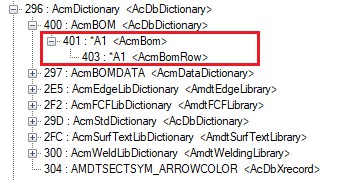BomRow and Bom
#### Conclusion
A Bill Of Materials is a set of dictionaries that has a subset of BOM items (rows) and data containers (data entries). Rows and entries are connected to each other, and rows are connected to components.
## Get started today
**Try ODA software free for 60 days.
No risk, no credit card required.**
[Try for Free](https://www.opendesign.com/free-trial)